
Wichita Falls City Directory Runs
The historical shelf begins with Worley volumes, but no single source proves an uninterrupted run. The Briscoe Center citation for Worley’s Wichita Falls City Directory identifies John F. Worley & Co. and lists January editions for 1912, 1928, 1930 through 1934, 1941, 1946, 1949, and 1957. Other historical citations establish scattered editions from 1907 onward. The Wichita Falls Public Library collection note says 1907 to present, which is useful for asking at the desk but does not establish that each year survives.
| Collection | Years | Where Held | Access |
|---|---|---|---|
| Worley city directories | Scattered 1907, 1909–1912, 1915, 1917–1925, 1928–1935; listed later editions through 1957 | WFPL/Prothro, UT Briscoe, library databases | Desk or database access, depending on volume |
| Gale U.S. City Directories group | 1909–1935, with gaps including 1915–1916 and 1923 | Subscription or library institutions | Institutional access |
| Wichita Falls telephone books | 1909–2005, with documented gaps | UT Briscoe and WFPL reference collections | Reference access |
| Sanborn map set | 1885, 1894, 1898, 1904, 1907, 1910, 1915, 1919, 1925 | MSU Moffett, UT/LOC, and library databases | Library or repository access |
The Briscoe Center’s Worley citation is shown below.
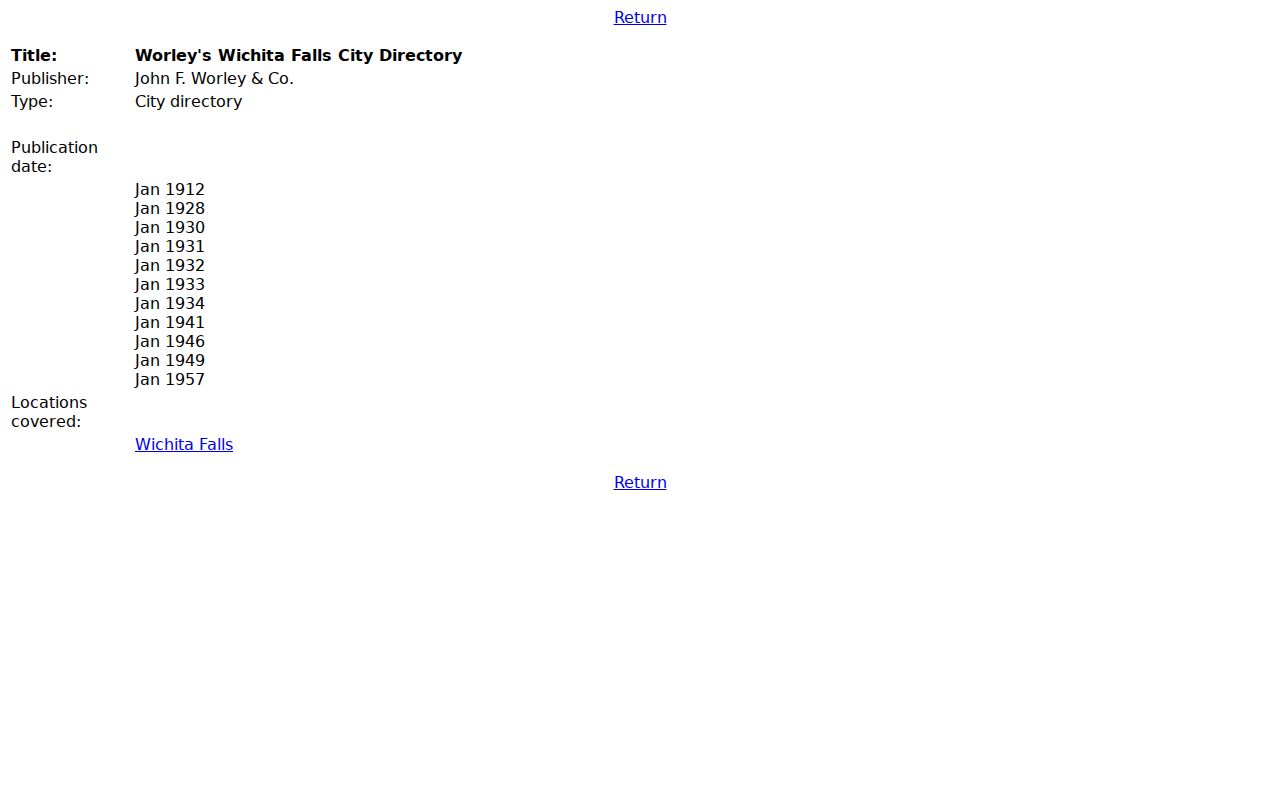
Use the cited year as a request key, then inspect the actual page because an indexed date does not reveal every printed field. The historical bibliography also names Worley editions for 1907, 1909, 1910, 1911, 1912, 1915, 1919, and 1925. A source may describe the same volume differently, so preserve its title wording and repository in the log. The library note is a collection lead, whereas the Briscoe citation is an edition-level confirmation.
Wichita Falls City Directory Yellow Sheets
A local 1910 report described a Wichita Falls directory with about 3,500 names for a city estimated at 10,000 people. It also described street-address lists printed on yellow sheets. That detail matters for house and family research: the address side was a deliberate part of the local product, not a modern add-on. The report does not mean every resident was listed. People could be omitted, recorded under initials, shown as boarders, or appear under a business connection.
Try the alphabetical and street portions together. A name hit can supply the address, while the address section can reveal a different spelling or another listed household. The yellow sheets are particularly useful when a modern spelling differs from the style used in an old volume. Preserve directional prefixes and street suffixes exactly, then test them against a map or plat rather than modernizing them on sight. Note: A missing entry may reflect the publication’s scope or timing rather than a move.
Wichita Falls City Directory Library Access
The Wichita Falls Public Library genealogy service is the first local stop for directory names, obituary leads, cemetery material, newspapers, census aids, and yearbooks. Its Texas Room is reference-only. The room holds more than 3,000 Texas and Southwest nonfiction volumes and nearly 500 biographies or autobiographies, and visitors should ask the Service Desk for access during library hours. The library also points researchers to a local cemetery index, state resources, and North Texas genealogy organizations.
The WFPL genealogy page is shown below.
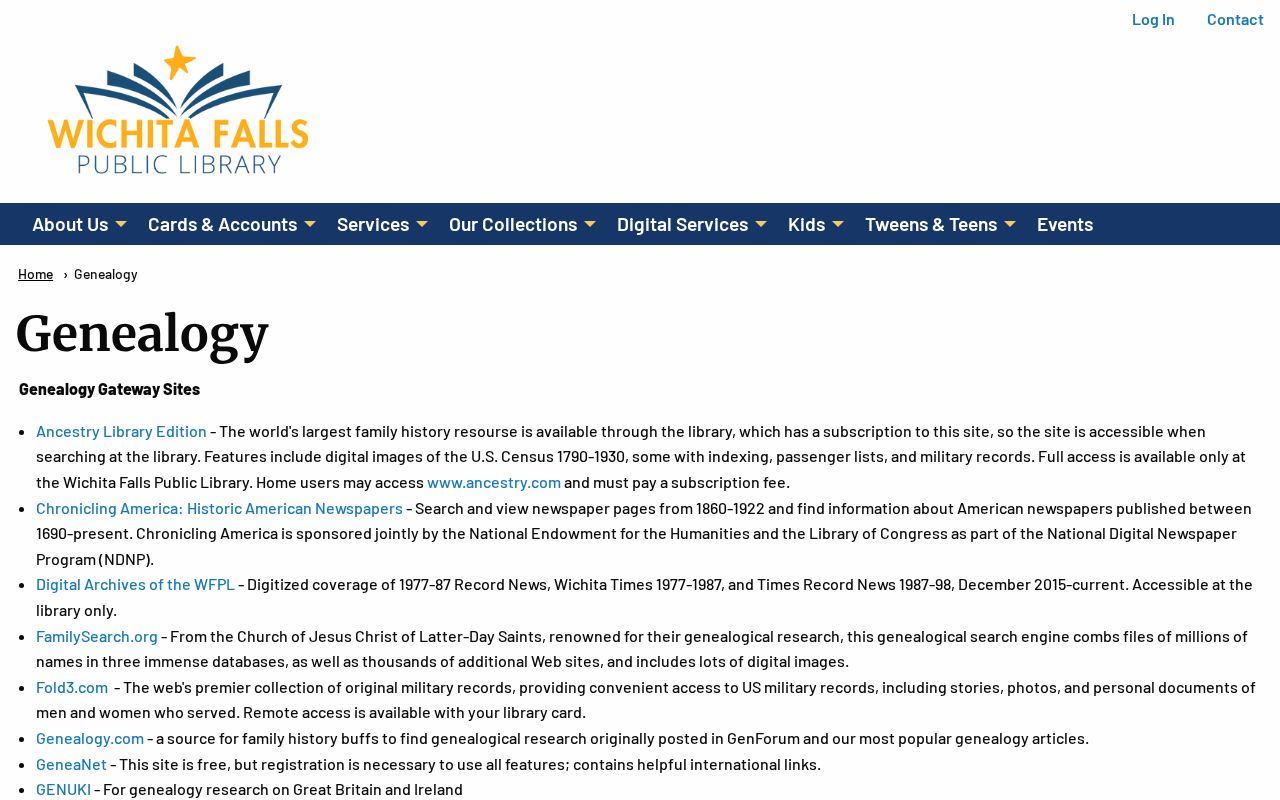
The library is especially helpful when the requested year is known but the directory’s exact shelf location or access condition is not published online. Its database material also supplies newspaper layers that can check a listing: Record News from 1977 to 1990, Wichita Times from 1977 to 1987, Times Record News from 1987 to 1998 and December 2015 to current, plus Wichita Falls Daily Times issues from 1911 to 1923 through NewspaperArchive. The date gaps are a reason to combine sources, not fill them with assumptions.
Wichita Falls Digital Directory Paths
Digital access is split by collection. WFPL database links identify local newspaper images, Sanborn Maps for Texas, and databases such as HeritageQuest. Ancestry Library Edition is in-library only. Other products may require a library card and PIN or TexShare access. The Briscoe Center’s Texas Collection Library has searchable directory-page material, although the unattended inspection exposed thumbnails rather than reliable person-line OCR.
The WFPL database list is shown below.
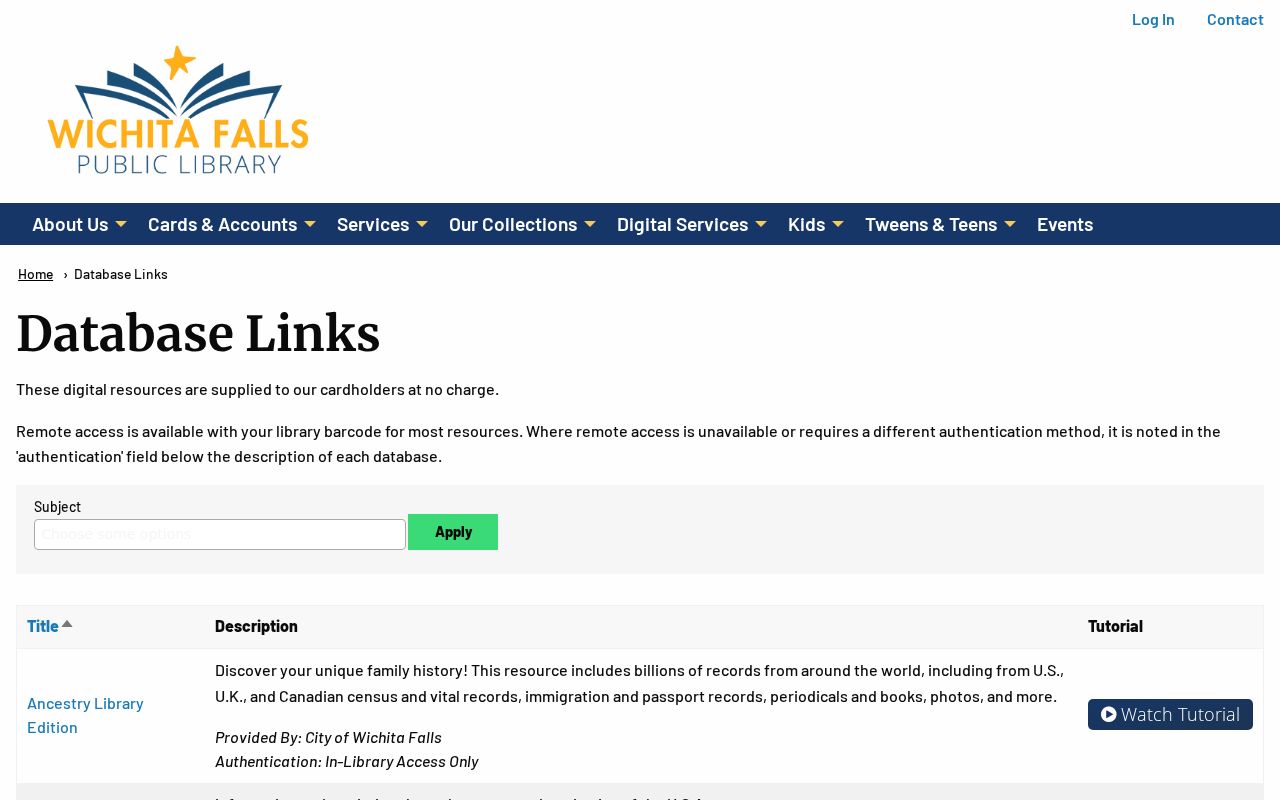
Save the title, year, and page image with each result, since a database search can hide abbreviations, page context, or an imperfect scan. Library authentication matters as much as the title. Ancestry Library Edition is available only inside the library, while HeritageQuest follows library or TexShare instructions. The local digital newspaper runs do not cover every decade, and the Briscoe interface may return collection-level results before a person-line result. For each hit, preserve the access date and the database that supplied it so another researcher can repeat the search.
Reading a Wichita Falls City Directory Entry
A city directory entry often combines an alphabetical residents or business section with a street or reverse section. The exact fields vary by volume. A line may show a name, street number and street, occupation, employer, spouse notation, widow notation, roomer or boarding status, or an owner/renter abbreviation. Treat each mark as a transcription task. Start by photographing or recording the volume’s introductory abbreviation key, then copy the entry exactly before translating it into plain notes.
| Name form | Record initials, suffixes, spouse or widow notation, and the spelling printed in that edition. |
|---|---|
| Street address | Capture the number, street, directional prefix, and whether the address appears in both sections. |
| Work reference | Occupation or employer can separate same-name people, but it may change between editions. |
| Household status | Boarder, roomer, owner, renter, or business labels are volume-specific and require the key. |
- Criss-cross directory
- A directory arranged by street address, used to locate listed occupants or subscribers at one address.
- Householder index
- An arrangement that identifies the household name associated with an address; it does not prove ownership.
- Abbreviation key
- The volume’s own explanation of short forms, usually near the front, which prevents a wrong reading of status notes.
Wichita Falls Telephone Directory Layer
Telephone books make a separate, later layer of Wichita Falls directory evidence. The Briscoe Center telephone-directory citation documents volumes from January 1909 to October 2005, with many gaps and regional coverage that includes nearby towns. The books use area codes 817 and later 940. Neither code defines a city boundary, and a subscriber listing does not establish that every person in a household had a telephone or appeared in print.
When a Worley address disappears, check the nearest available telephone book before assuming the household left Wichita Falls. Compare the street spelling and any regional place label. The Briscoe run spans local and regional communities such as Burkburnett, Iowa Park, Holliday, and Henrietta, so a city label and area code should be logged with the volume. A matching subscriber can support a timeline, but a nonmatch is not a final answer.
Trace a Wichita Falls City Directory Household
Family history becomes more reliable when each directory year is logged rather than remembered. Start with the address if it is known, then use the alphabetical section to preserve the name form and work information. Compare the next available edition, even when years are missing. A changed spouse notation, employer, or street can identify the right household, while a gap needs another source before it is treated as a move.
- Normalize the street suffix, directional prefix, and any lot or block description in the research notes.
- Find the address in the street or reverse section, then copy the related alphabetical entry and abbreviation key.
- Record the first and last appearance, changed occupation, spouse or widow notation, and every address variation.
- Pair the directory dates with the available federal census images and compare composition, ages, birthplaces, and occupations.
- Use deeds, tax rolls, permits, maps, obituaries, or probate records to test the changes rather than assuming they prove one event.
For a modern name check after a historical lead, use the separate Wichita Falls resident lookup workflow rather than treating a decades-old entry as current.
Wichita Falls City Directory Census Pairing
Directory years fill the long spaces between census snapshots. Federal census images are public through 1950 under the 72-year rule, while 1960 was not public as of the research date. Use the closest directory before and after a census year, but do not expect the two sources to have been collected on the same day. Census geography may also differ from the city line, especially where a Wichita Falls mailing label reaches beyond municipal boundaries.
The reconstructed 1890 Wichita County census listed by local genealogy resources is a useful research aid, not a replacement for the largely destroyed federal schedules. For a Wichita Falls household, compare the exact street and the surrounding names only after confirming the historical address form. Census, directory, and tax entries can use a county, rural, military, or regional label that is not identical to the city label used today.
Wichita Falls Directory Copies: Screen or Shelf
Online cataloging is fast, but physical and microfilm holdings often expose the gaps that a landing page cannot. The Texas State Library Wichita County guide identifies exact county reel series, while Midwestern State University’s Moffett Library serves as the regional historical repository. Ask for a title, year, or reel number instead of a broad resident list. That request gives staff a defined item to locate and keeps the trail tied to a time period.
The Wichita County Heritage Society is shown below. Its Kell House Museum and preservation work can help put a building, institution, or historic family inquiry in local context, though it does not publish an online people index.
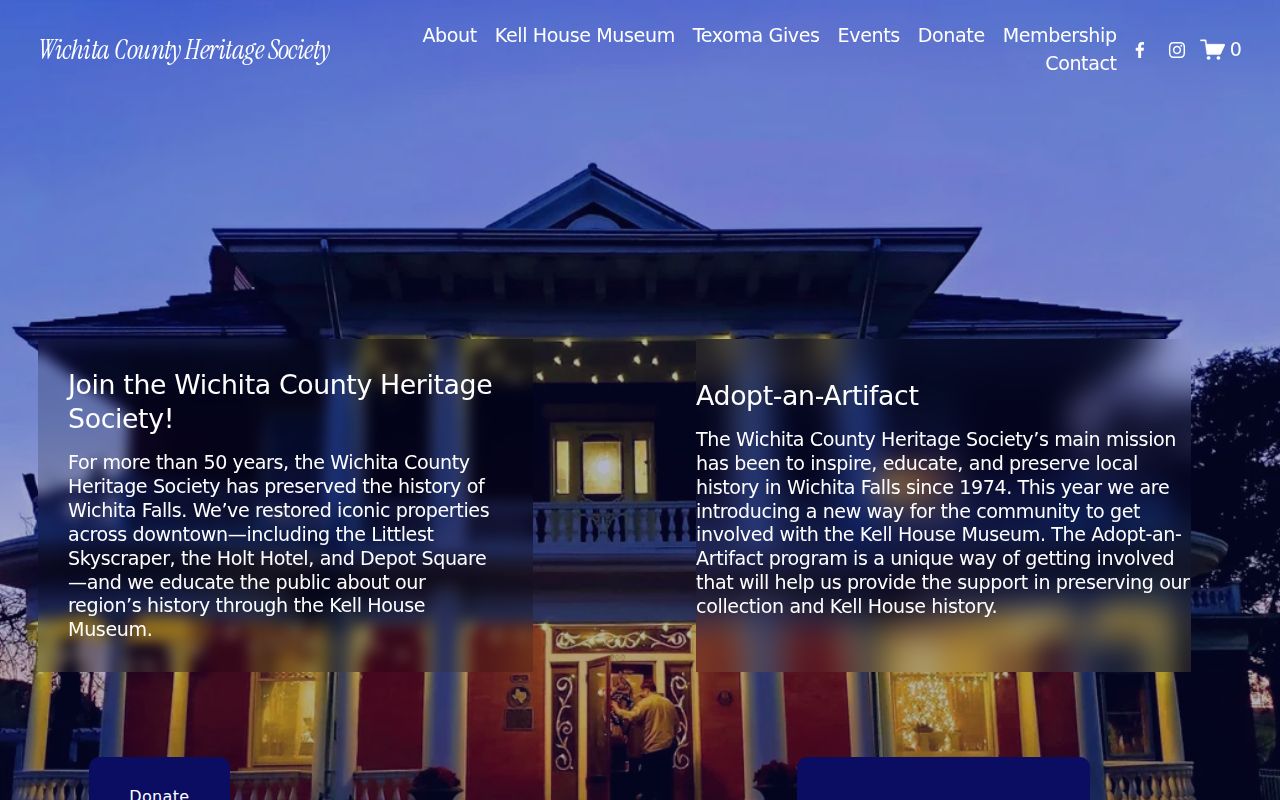
Depot Square’s documented fire, restoration, and reuse illustrate why a directory entry should be checked against property and local-history sources before drawing conclusions about a place.